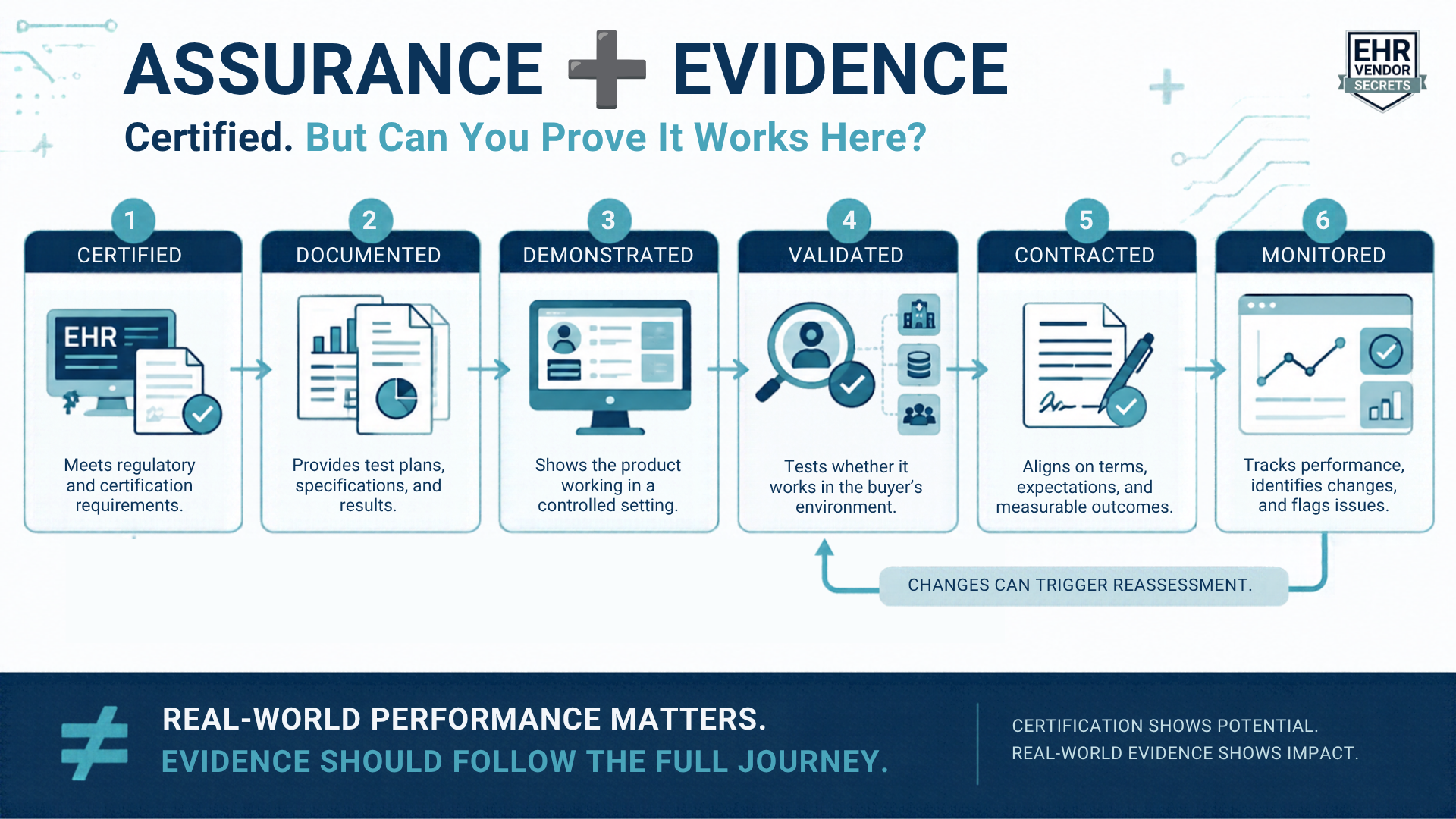
Assurance ≠ Evidence Certified. But Can You Prove It Works Here?
Certification is useful assurance. Buyers still need evidence that the capability, standard, disclosure, and performance expectation apply to the exact technology they are buying, in the environment where it will be used, and remain true through contracting, implementation, upgrades, and ongoing operations.

Certification can mean more in the buyer’s mind than it means in the rule
Certification matters. It gives healthcare organizations a standardized way to know that technology met defined requirements.
But somewhere between the certification record, the sales presentation, the demonstration, and the contract, certified can start to take on a much bigger meaning.
Validated.
Proven.
Safe.
Ready.
Tested in conditions like ours.
Appropriate for our patients.
Compatible with our configuration.
Capable of supporting the workflow we were shown.
Those are not necessarily the same thing.
Certification can establish that a product or capability met specific criteria under a defined framework. That is useful assurance. The healthcare organization still has a different question to answer:

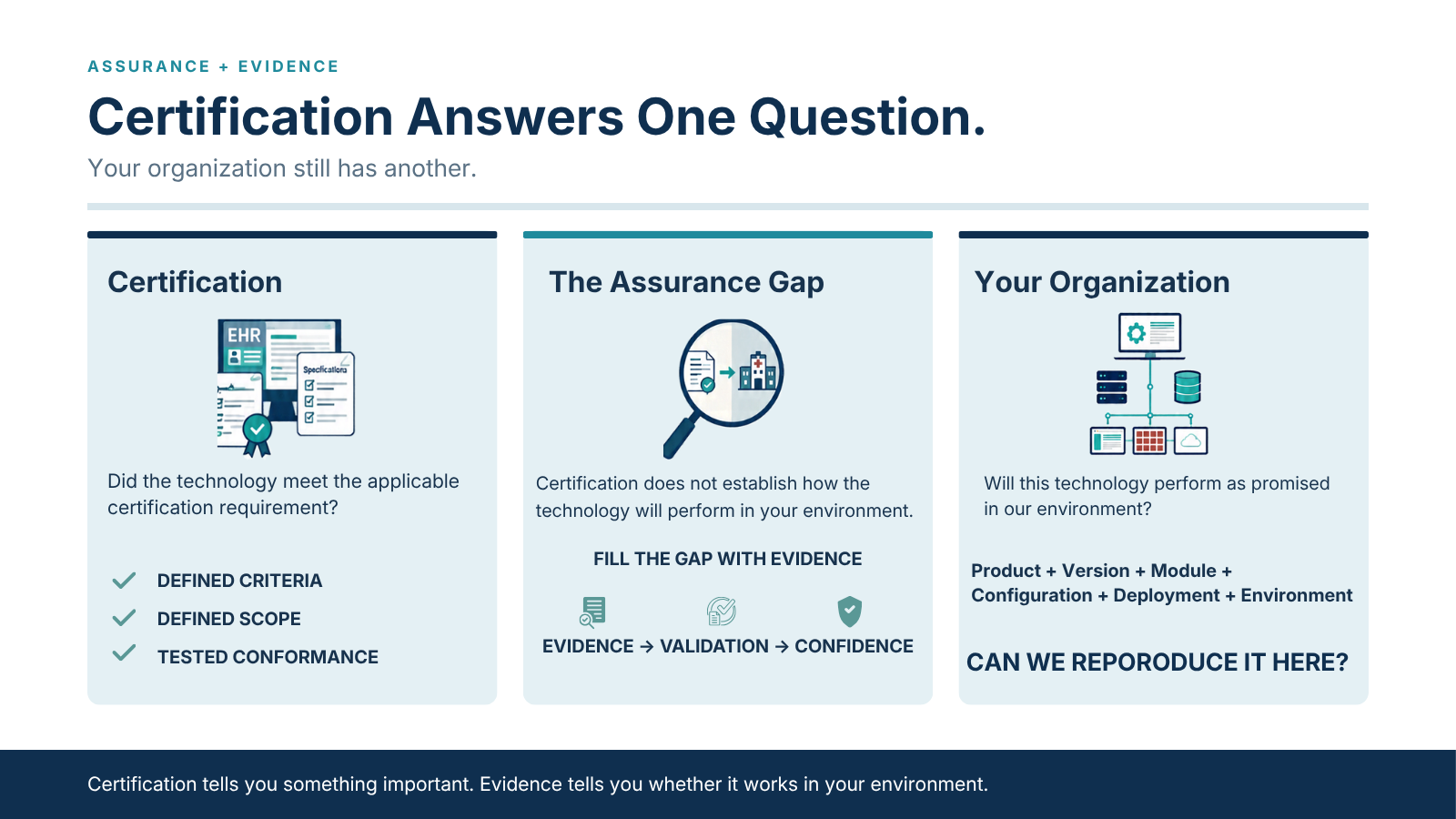
That question requires evidence. Buyers need to understand what is actually assured, what evidence exists, what has been demonstrated, whether that evidence applies to the exact system being purchased, what remains unknown, what must be validated locally, and what must remain true after the contract is signed.
For the capabilities that matter most, one practical validation question follows:

That question connects a vendor claim to the organization’s actual data, configuration, interfaces, workflows, users, patient populations, dependencies, and exception paths.
How to use this guide
Use the six-stage evidence chain for every capability that could materially affect patient safety, clinical workflow, interoperability, reporting, accessibility, security, operations, cost, or regulatory performance. The depth of review should match the risk. A routine preference may need a demonstration. A high-risk clinical, reporting, exchange, or artificial intelligence capability may require documentation, local validation, contract protection, and ongoing monitoring.
Create one evidence record for each material claim. Name the product, version, module, deployment model, configuration, dependencies, environment, vendor statement, supporting documents, demonstration result, validation result, contract location, owner, and reassessment trigger. This prevents evidence for one system or release from being mistaken for proof about another.
Do not require every item to pass through every stage in the same way. Instead, make the decision explicit: which stages apply, what level of evidence is proportionate, who can accept remaining risk, and where the decision is recorded.
The six-stage buyer evidence chain
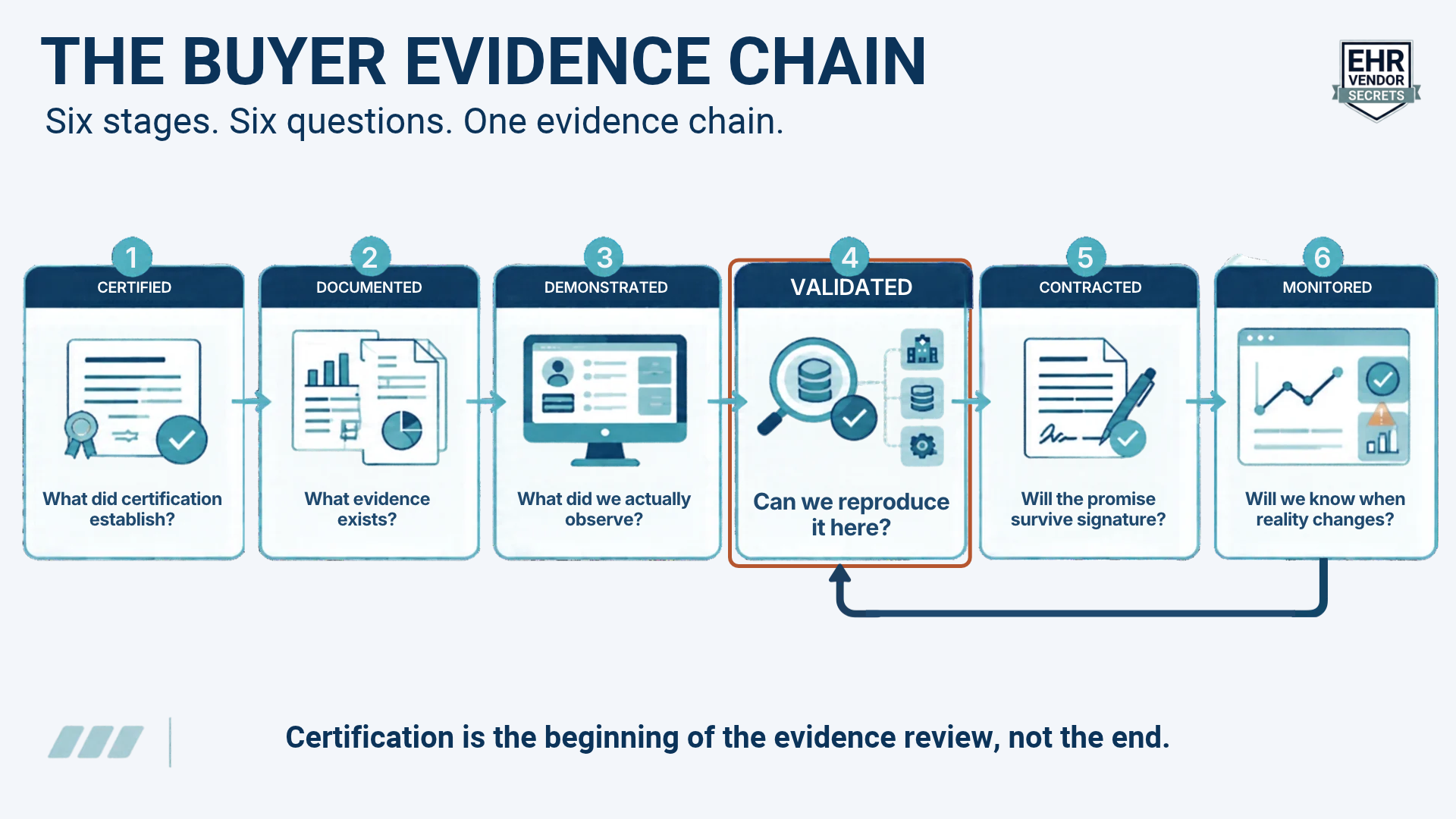
A disciplined evaluation separates six related stages. Each stage answers a different question. The stages build on one another, but they are not interchangeable.

Do not stop at asking whether the product is certified. Ask certified for what.
Which product and version?
Which modules and certification criteria?
Which capabilities are included, and which are not?
What effective dates and transition dates apply?
What changes when the product is upgraded?
A certification label is most useful when the organization understands exactly what sits underneath it. Treat certification as a defined assurance baseline, not as a permanent promise that every future release, configuration, connected component, or local workflow will perform the same way.
How to answer the certification question
Start with the Certified Health IT Product List entry or other applicable certification record. Confirm the certified product name, developer, certification identifier, edition or program, version, practice setting, certification date, certification status, criteria, standards, and any disclosures or additional software listed.
What a strong answer includes
An exact match between the certification record and the product, version, modules, and deployment model being proposed.
A criterion-level explanation of what was tested, attested to, or otherwise required, rather than a general statement that the product is certified.
Identification of criteria that were removed, revised, expired, narrowed, or are not applicable to the proposed system.
A clear explanation of what certification does not establish, including local workflow fit, production reliability, implementation quality, cybersecurity maturity, accessibility outcomes, clinical suitability, reporting acceptance, or future performance.
Questions to ask the vendor
Show us the certification record for the exact product and version in this proposal.
Which modules, interfaces, services, and third-party components are outside that certification record?
Which capabilities in the proposal are included because of certification, and which are commercial features that may change independently?
What certification changes, expirations, or transition dates affect the term of our agreement or planned implementation?
Red flags
The response relies on a company-level certification statement instead of the product-level record.
The demonstrated or proposed version does not match the certified version.
The vendor cannot explain which requirements were tested versus attested to.
The organization treats the certification mark as proof of safety, usability, local fit, or regulatory compliance.
Evidence to retain
Save the certification record, applicable disclosures, criteria list, standards and version information, screenshots or exports, the date verified, the person who verified it, and any vendor explanation needed to interpret the record.

If a capability is important to the buying decision, ask for the evidence supporting it. The evidence should be proportionate to the risk and importance of the claim.
How to evaluate supporting evidence
Match the evidence request to the claim and the risk. The goal is not to collect a large document library. The goal is to obtain enough reliable, version-specific information to understand what was tested, under what conditions, with what result, and with what limitations.
For every material document, record:
The claim or capability the document supports.
The product, version, module, configuration, deployment model, and test environment.
The test method, sample, data source, users, workflow, expected result, actual result, exceptions, and unresolved defects.
The author, organization, date, approval status, and whether the evidence is vendor-produced, customer-produced, independently assessed, or regulator-produced.
The assumptions, exclusions, known limitations, dependencies, and conditions that would make the evidence no longer applicable.
Evidence examples by risk area
Interoperability: supported standards and versions, implementation guides, interface specifications, conformance results, endpoint requirements, data mapping, error handling, reconciliation, and production acknowledgement.
Clinical workflow and usability: user-centered design documentation, safety analyses, task success, critical errors, representative-user testing, known workflow constraints, and post-live issue data.
Artificial intelligence and decision support: intended use, excluded uses, training and validation data, subgroup performance, thresholds, human oversight, update process, drift monitoring, incident response, known limitations, and customer responsibilities.
Reporting: measure specifications, value sets, logic, test cases, numerator and denominator reconciliation, exclusions, generated files, submission acknowledgements, and correction workflow.
Accessibility: applicable standard, testing method, assistive-technology coverage, unresolved defects, accommodation process, and release-level regression testing.
Red flags
A marketing sheet is presented as test evidence.
The evidence omits the version, test conditions, sample, limitations, or failed cases.
The vendor provides evidence for a future release or different deployment model.
The buyer cannot retain or review evidence that materially influenced the decision.
Evidence to retain
Maintain an evidence index that links every material claim to the document, version, owner, review result, open issue, and expiration or reassessment condition.
Test and validation documentation
Intended-use statements and known limitations
Performance information and data provenance
Implementation requirements and configuration dependencies
Version information and change history
Interoperability specifications and third-party dependencies
Risk-management information, user documentation, and available Real World Testing information

Documentation is not demonstrated performance. This is where healthcare organizations can fall into the demo trap.
A clean patient. Complete data. An ideal workflow. A perfectly trained presenter. No interruptions. No difficult handoffs. No missing information. No edge cases. No integration problem. Everything works.
Real healthcare rarely does.
A buyer-controlled demonstration should deliberately introduce the conditions the organization cares about. Define the current problem. Include the exception. Include the handoff. Include missing or conflicting information. Include realistic patient complexity. Then ask the vendor to show how the system supports that work.
Also speak with a current customer using the same functionality in production. Ask what implementation required, what the capability depends on, what changed after upgrades, what failed, and how the workflow performs on an average day.
Document whether the demonstrated capability is available out of the box or depends on configuration, customization, another module, another vendor, professional services, workflow redesign, or a future release. Score demonstrated performance as demonstrated performance. A promise about future capability belongs somewhere else.
How to run a buyer-controlled demonstration
A useful demonstration begins with the organization’s current problem and desired outcome, not with the vendor’s menu. Use identical scenarios, instructions, time limits, evaluation criteria, and scoring rules for every vendor. Require the presenter to identify when the workflow leaves the proposed product or depends on another module, interface, service, manual process, or future release.
Build each scenario with
The user roles involved and the setting in which the work occurs.
A realistic patient or operational story, including comorbidities, missing or conflicting data, interruptions, handoffs, and exception paths.
The starting condition, required steps, expected outcome, safety risks, and failure conditions.
The current-state problem and the measure the organization wants to improve.
The evidence the vendor must identify during the demonstration, including whether the capability is standard, configured, customized, third-party, service-dependent, or planned.
What to record during the demonstration
What was actually shown, who performed it, which environment and version were used, and whether test data were representative.
Workarounds, duplicate entry, deferred answers, manual steps, alerts, handoffs, searches, clicks, screens, delays, and user decisions.
Any difference between the requirement, the vendor narrative, the demonstrated behavior, and the evaluator’s observation.
Unanswered questions and the evidence needed to close them.
Scoring rule
Score only what was observed under the agreed scenario. Record configuration, customization, third-party technology, services, and future development separately. A promised capability should not receive the same score as a demonstrated capability.
Red flags
The vendor substitutes a standard script for the buyer’s scenario.
The presenter skips exception handling or says the difficult steps will be addressed during implementation.
The demonstration uses a different product, version, module, or integration than the proposal.
Evaluators score preference or visual appeal without connecting the score to the defined workflow problem and desired outcome.

A product can satisfy certification requirements, have strong documentation, and perform well in a demonstration, yet behave differently in another organization’s environment.
Your environment is not generic. It includes different data, interfaces, configuration choices, clinical workflows, policies, patient populations, staffing models, operating constraints, exception paths, and interactions with the rest of the technology ecosystem.
Can we reproduce it here? |
If the answer is yes, document how. If the answer is no, understand why. If the answer is not yet, do not score it the same way as something already validated.
How to validate the capability locally
Local validation asks whether the proposed system can produce the needed result with the organization’s data, configuration, interfaces, policies, users, patient populations, and operating conditions. It should be planned before contract signature whenever the result could materially affect the purchase decision.
Define the validation package
The requirement, claim, acceptance criterion, test owner, test environment, prerequisites, and due date.
Representative data, user roles, locations, devices, interfaces, security controls, workflows, patient populations, jurisdictions, and exception cases.
Expected results, objective pass and fail thresholds, defects, retest rules, evidence to capture, and approval authority.
The difference between a vendor test, a joint test, an independent test, and an operational pilot.
Use traceable test cases
Assign each material requirement a unique identifier and connect it to one or more test cases. Each test case should record the input, steps, expected result, actual result, evidence, defect, disposition, retest result, and final approval. If a requirement cannot be validated before signature, identify the condition as a contract deliverable or acceptance gate rather than assuming it will work.
Worked example: automated measure calculation
Do not stop with successful file creation or submission. Use known patient cases to independently determine the expected numerator, denominator, exclusions, and exceptions. Compare those results with the system’s calculation, confirm the applicable measure specification and value sets, inspect filtering and mapping, generate the submission file, reconcile the acknowledgement, test corrections, and repeat after material upgrades or specification changes.
Worked example: predictive decision support
Test the intended workflow, representative patient groups, missing data, out-of-range values, thresholds, overrides, alert routing, auditability, and failure modes. Confirm who reviews performance, how model or logic changes are disclosed, how incidents are handled, and what will trigger revalidation.
Red flags
Validation is postponed until after the organization is commercially committed.
The test uses only ideal data or vendor-selected cases.
Pass criteria are subjective or written after results are known.
A failed test is reclassified as configuration, training, or workflow redesign without a documented corrective action and retest.
Evidence must match what you are actually buying
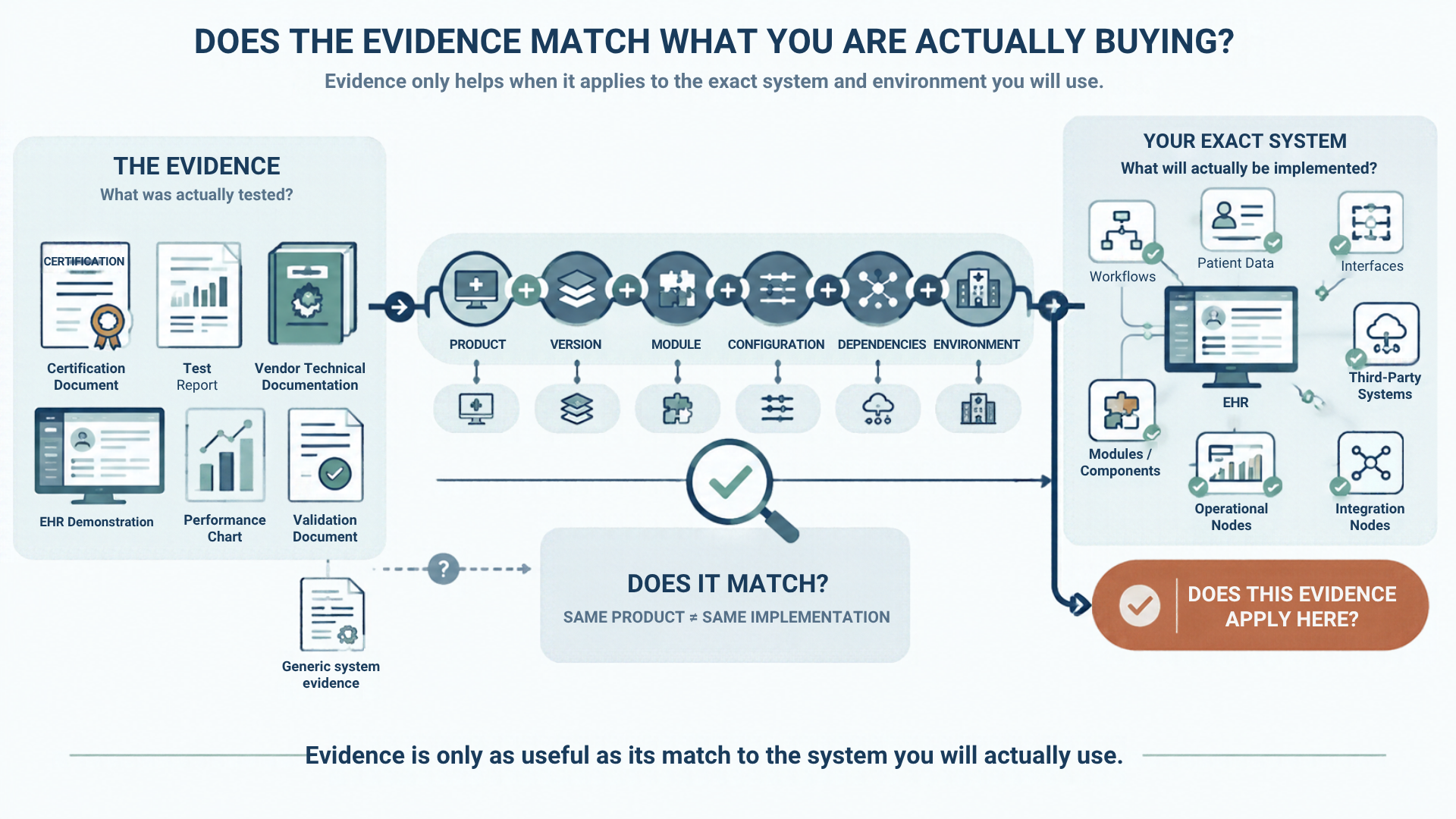
A vendor may present evidence for one product version while the buyer contracts for that product plus separate modules, third-party components, custom configuration, interfaces, services, and a different upgrade path.

For every material claim, confirm that the documentation, demonstration, local validation, contract, and monitoring plan all point to the same system. Evidence for another version, deployment model, or future release should be documented separately, not scored as proof for the environment being purchased.
HTI-5 makes the assurance gap easier to see
HTI-5 changes the assurance baseline. It does not eliminate the organization’s need to determine whether the technology will work in its environment.
Of the 60 certification criteria in effect, the final rule removes 14, revises seven, and leaves 39 unchanged. The changes reduce compliance obligations for certified health IT developers, but they do not eliminate the clinical, operational, technical, accessibility, reporting, governance, or risk management needs of healthcare organizations.
Three examples show why buyers need to separate certification assurance from accessible evidence.
What HTI-5 changes for the buyer
HTI-5 is not a reason to assume that previously certified functionality disappears. It is a reason to identify which assurances remain in the Certification Program, which were revised or removed, which transition dates apply, and which buyer expectations now depend more heavily on procurement, validation, contract language, law, policy, governance, or market practice.
The final rule takes effect on December 28, 2026, except for specified provisions effective January 1, 2027. It removed 14 certification criteria, revised seven, and left 39 unchanged. Some proposed removals were not finalized, including all privacy and security certification criteria and several public health reporting criteria. Buyers should therefore evaluate criterion by criterion rather than describing HTI-5 as a blanket removal of certification safeguards.
Use a change-impact worksheet
What capability or obligation did the organization previously associate with certification?
Was the applicable criterion retained, revised, removed, expired, delayed, or replaced? On what date?
Does another law, CMS program requirement, contract term, technical standard, organizational policy, or operational control still require the capability?
Does the current vendor agreement preserve the functionality, evidence access, support, pricing, change notice, and remediation the organization needs?
What new validation or monitoring is needed because standardized certification evidence or reporting has changed?
AI transparency
HTI-5 removes the source-attribute requirements that supplied standardized information about evidence-based and predictive decision support interventions. It also removes the certification requirement for intervention risk management for predictive decision support tools.
That does not make intended use, training and validation information, subgroup performance, known limitations, model changes, monitoring, or incident support unimportant. It means buyers should not assume certification will supply that information. If those details influence the purchase or governance decision, request them, validate the technology’s behavior in the intended workflow, and decide where continued disclosure and change notification will be protected.
Real-world testing
The obligation to conduct Real World Testing remains for applicable criteria, but annual plan submissions are eliminated and full public results reporting is limited to API-focused criteria.
This is a useful example of assurance versus accessible evidence. Testing may still occur while the buyer’s access to standardized plans, methods, and results becomes more limited. When production performance matters, ask for version-specific methodology, conditions, outcomes, defects, exceptions, and changes directly.
Measure calculation
The automated numerator recording and automated measure calculation certification criteria are removed effective January 1, 2027. Healthcare organizations still remain responsible for accurate reporting.
Do not treat file generation or successful submission as proof that the underlying calculation was correct. Validate numerator, denominator, exclusions, exceptions, value sets, filtering, file generation, submission, reconciliation, and correction as distinct steps.


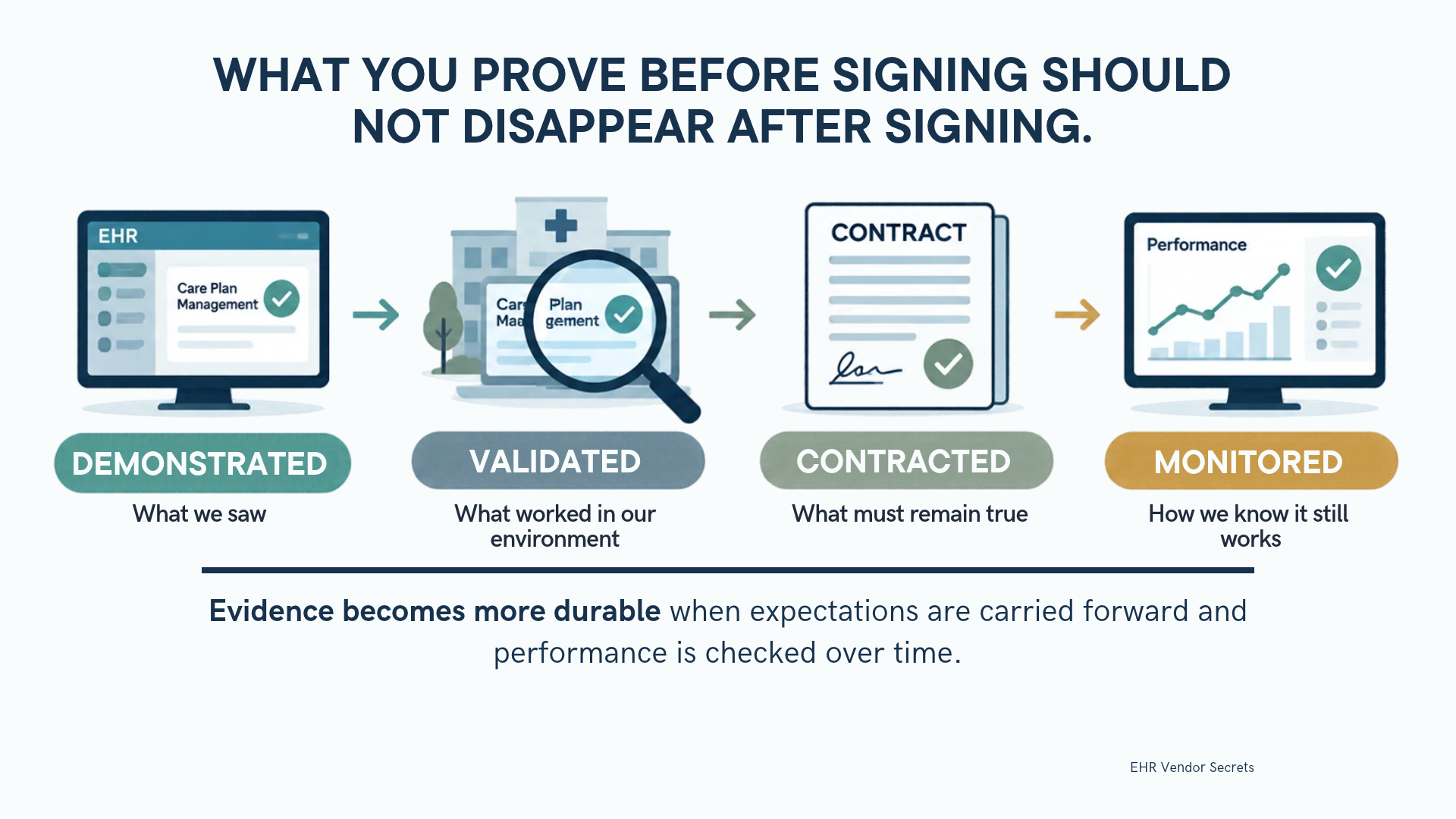
If you are relying on it, put it in writing
A capability may influence the buying decision because it was required by certification, shown in a demonstration, described in documentation, or promised during negotiations. None of those automatically guarantees that the capability will remain included, perform the same way after an upgrade, stay available on the same commercial terms, or continue to match the system that was evaluated.

For some requirements, another law or regulation may provide the answer. For others, the answer may be organizational policy, acceptance testing, technical validation, governance, or an express contractual obligation.
The goal is not to copy certification criteria into the agreement. The goal is to identify what the organization is relying on and decide where that expectation lives after signature.
Required functionality, applicable standards, and supported versions
Configuration assumptions, implementation responsibilities, and third-party dependencies
Testing requirements and objective acceptance criteria
Documentation and evidence access
Material limitations and known issues
Change notification, version changes, and revalidation triggers
Service levels, remediation obligations, and incident support
Continued support, packaging, fees, and responsibilities when performance no longer matches what was represented
Not everything belongs in the contract. But anything the organization is unwilling to lose deserves an explicit decision about where the requirement will live. The exact contractual mechanism will depend on the transaction and should be reviewed by qualified legal counsel.
How to turn relied-upon claims into durable obligations
Build a reliance register before negotiations end. For every claim that materially influenced the decision, identify the source, the exact system it applies to, the evidence reviewed, the required outcome, and where the obligation will live after signature. The location may be the main agreement, statement of work, specification, requirements exhibit, service level schedule, business associate agreement, data-use terms, implementation plan, acceptance plan, governance charter, or organizational policy.
Write requirements so they can be tested
Name the required capability, supported standard and version, product and module, configuration assumptions, environment, dependencies, and applicable use cases.
Define the deliverable, test method, data, objective acceptance criteria, evidence, timing, defect classification, correction period, retest, and approval authority.
Define what is included in license, implementation, interfaces, upgrades, maintenance, hosting, third-party services, and professional services, including fees and responsibilities.
Require notice of material changes to functionality, standards, versions, hosting, models, data sources, dependencies, packaging, support, or certification status.
Define remedies when the system does not meet the agreed requirement, such as correction, workaround approval, service credit, fee adjustment, delayed acceptance, termination right, data return, transition support, or other negotiated relief.
Questions for contract review
Could the vendor remove, repackage, or charge separately for a capability the organization relied on?
Does an order form, online policy, product guide, or incorporated document allow unilateral change?
Are demonstration statements or proposal responses excluded by an integration clause?
Who owns interface testing, data conversion, configuration, third-party coordination, and remediation?
What happens if an upgrade changes a validated workflow or invalidates prior evidence?
Red flags
The agreement names a feature but not the result, standard, version, or acceptance method.
The vendor can satisfy the obligation with a future roadmap item or additional paid service.
The contract disclaims materials that the selection committee relied on without restating the requirement elsewhere.
There is no remedy or revalidation process when performance changes after acceptance.

Validation is not permanent. Technology, versions, configurations, interfaces, data, models, clinical workflows, patient populations, staffing, and operating conditions change.
Evidence should have expiration conditions, not just a date. Before accepting evidence, define which changes make the prior evidence insufficient and require review or revalidation.
A major product-version change
AI model retraining or a change in training data
A change in algorithm logic, thresholds, or intended use
A major configuration or workflow redesign
A new interface, exchange pathway, patient population, or care setting
A standards, implementation-guide, measure-specification, value-set, or mapping update
A security architecture, hosting, patient-portal, or accessibility redesign
A new third-party dependency or material change in data quality or volume

Before deployment, define what will be monitored, who owns the monitoring, what triggers review, how degradation will be detected, who receives incident information, when the vendor must be involved, when revalidation is required, and what happens when observed performance no longer matches expectations.
That is how assurance becomes governance.
How to build an evidence monitoring plan
Monitoring should connect the original requirement to actual performance after implementation. Define the measure, data source, baseline, target, frequency, owner, review forum, threshold, escalation path, vendor involvement, corrective action, and revalidation trigger before go-live.
Monitor four kinds of change
Technology change: product releases, patches, configuration, interfaces, hosting, security architecture, third-party components, models, algorithms, and data pipelines.
Operational change: workflows, staffing, policies, facilities, service lines, volumes, jurisdictions, and care settings.
Evidence change: new defects, incidents, complaints, audit findings, performance drift, accessibility findings, reporting rejections, or customer experience.
External change: laws, program requirements, standards, implementation guides, value sets, measure specifications, registries, threats, and certification requirements.
Define thresholds before problems occur
Examples include an error rate above the accepted level, a material drop in subgroup performance, a failed interface acknowledgement, a reporting discrepancy, an increase in manual work, a safety event, a change in intended use, or a major release affecting the validated workflow. A threshold should name the required response: investigate, notify, pause, mitigate, retest, obtain approval, or suspend use.
Maintain the evidence record
Link incidents, changes, releases, tests, decisions, waivers, and corrective actions to the original requirement.
Record who accepted residual risk and for how long.
Set review dates, but also define event-based expiration conditions.
Close the loop by updating requirements, training, workflow, contract administration, and future procurement criteria based on what monitoring reveals.
Use the seven-question assurance-gap review
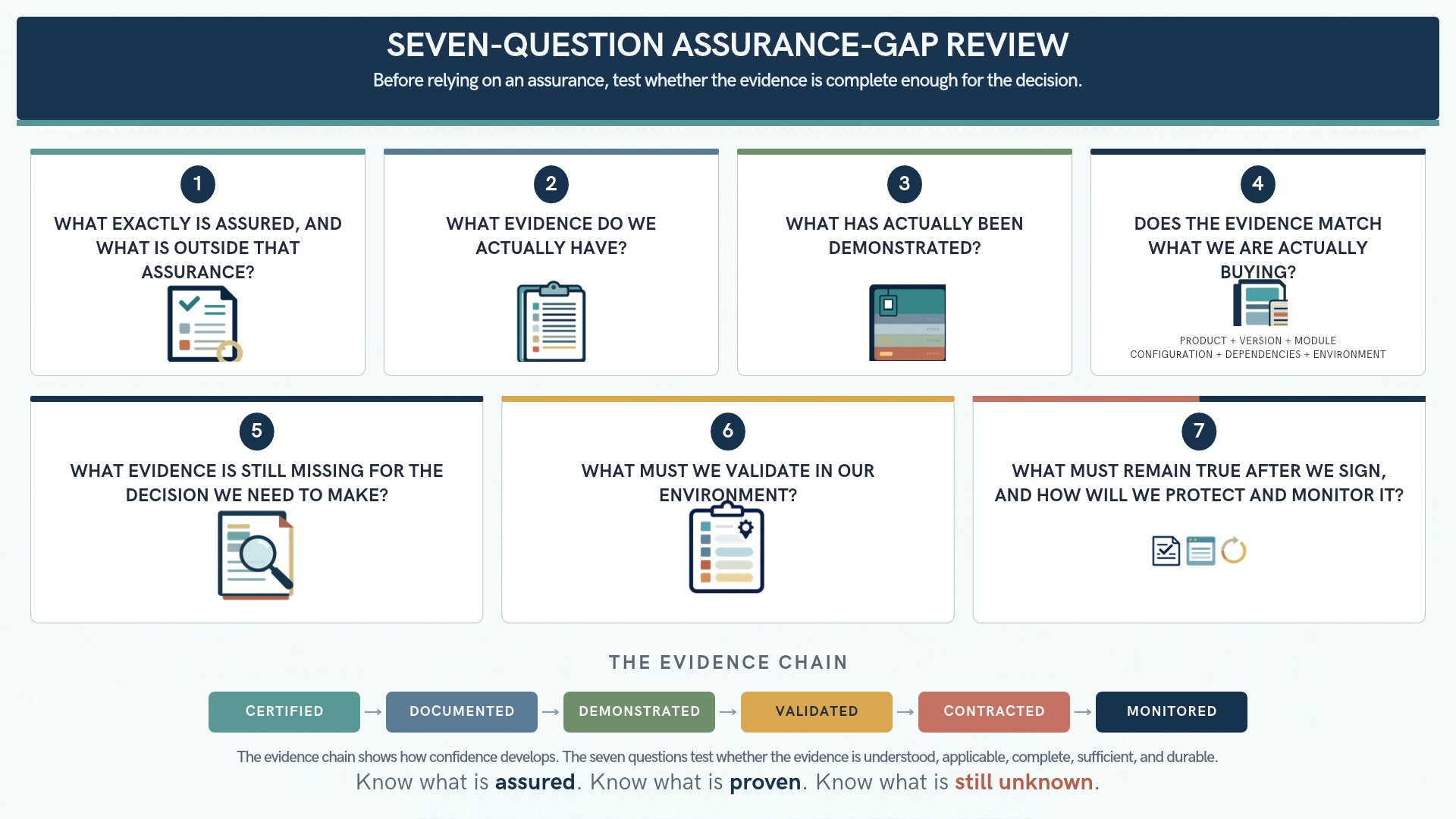
For every capability or certification criterion that matters to the decision, answer seven questions before treating certification as sufficient evidence. The six-stage evidence chain shows how confidence develops. The seven-question review tests whether the evidence is understood, applicable, complete, sufficient for the decision, and durable over time.
How to apply the seven-question review
Complete the review at the capability level, not once for the entire product. A single EHR may require different evidence for decision support, transitions of care, accessibility, patient access, reporting, data conversion, downtime, cybersecurity, and other high-impact functions.
Question 1: What exactly is assured, and what is outside that assurance?
Name the criterion, certified product and version, modules, conformance method, applicable standards, tested or attested requirements, effective dates, certification status, and known limitations. State what the assurance does not establish, including local workflow fit, production reliability, implementation quality, cybersecurity maturity, accessibility outcomes, clinical suitability, reporting accuracy, third-party performance, and continued performance after change.
Question 2: What evidence do we actually have?
Inventory the evidence supporting each material claim. Record the product, version, module, configuration, deployment model, test environment, methodology, sample, data source, users, expected and actual results, exceptions, unresolved defects, provenance, approval status, limitations, dependencies, and conditions that would make the evidence no longer applicable. A marketing statement is not test evidence.
Question 3: What has actually been demonstrated?
Document what the buyer observed under agreed, buyer-controlled scenarios. Record the environment and version used, representative data, exception paths, handoffs, workarounds, manual steps, unanswered questions, and whether the capability was available out of the box or depended on configuration, customization, another module, another vendor, professional services, workflow redesign, or a future release. Score demonstrated performance, not promised capability.
Question 4: Does the evidence match what we are actually buying?
Apply the Exact-System-Match test: Product + Version + Module + Configuration + Dependencies + Environment. Confirm that the certification record, documentation, demonstration, proposed validation, contract, and monitoring plan all point to the same system. Evidence for another version, deployment model, customer environment, or future release should be documented separately, not treated as proof for the system being purchased.
Question 5: What evidence is still missing for the decision we need to make?
After reviewing the assurance baseline, available documentation, demonstrated performance, and exact-system applicability, identify the important uncertainty that remains. Consider clinical safety, interoperability, accessibility, security, reporting accuracy, workflow impact, reliability, implementation requirements, artificial intelligence performance, relevant patient populations, exception handling, upgrade behavior, third-party performance, and customer production experience. Define what additional evidence is necessary and why it is proportionate to the risk.
Question 6: What must we validate in our environment?
Translate the remaining claims and uncertainties into local tests or pilots using the organization’s actual data, configuration, interfaces, policies, users, patient populations, operating conditions, and exception cases. Define the requirement, traceable test cases, expected result, objective pass and fail thresholds, evidence, owner, approval authority, defects, retest rules, and due date. If validation cannot occur before signature, make the uncertainty visible and protect the organization through acceptance conditions.
Question 7: What must remain true after we sign, and how will we protect and monitor it?
Identify the functionality, standards, versions, assumptions, evidence access, acceptance criteria, change notices, services, pricing, support, and remedies the organization is relying on after signature. Name the decision, evidence, contract, operational, and monitoring owners, including the person authorized to accept remaining risk. Define review frequency, escalation paths, performance thresholds, event-based expiration conditions, and the product, model, configuration, interface, workflow, population, standards, security, accessibility, dependency, incident, or regulatory changes that trigger review or revalidation.
Minimum output of the review
A documented answer to all seven questions, including the Exact-System-Match and evidence-sufficiency tests.
A risk-rated decision: accept, accept with conditions, obtain additional evidence, validate, contract, monitor, defer, or reject.
Named decision, evidence, validation, contract, operational, and monitoring owners, with due dates for every open item.
A traceable link from assurance scope to evidence, demonstrated performance, exact-system applicability, missing evidence, local validation, contract protection, monitoring, and reassessment triggers.

Build the evidence chain before the contract is signed
The stages are related. They are not interchangeable.
A vendor statement is not documentation.
Documentation is not a demonstration.
A demonstration is not local validation.
Local validation is not a contractual commitment.
A contractual commitment is not ongoing monitoring.
Certification is not all six.

A practical validation question may be surprisingly simple
When a vendor says, “Yes, we are certified for that,” the appropriate response is not suspicion. It is curiosity.
Great. What exactly is assured, and what is outside that assurance?
Show us the supporting evidence.
Show us what has actually been demonstrated.
Show us what requires configuration, customization, another product, additional services, or future development.
Show us that the evidence applies to the exact system we are buying.
Show us what is still unknown or unproven.
Let us test what matters against our reality.

That is not anti-vendor. A strong vendor should benefit from a buyer who knows the difference between an unsupported promise and demonstrated performance. A disciplined evaluation creates clearer requirements, cleaner expectations, fewer surprises, and a better foundation for both sides.
The bottom line
Certification matters. Healthcare organizations cannot afford to make certification mean more than it actually establishes.
The evidence needed for an important technology decision may extend beyond a certification label, a product document, a demonstration, or a contractual promise. The organization has to connect those pieces, preserve the connection through implementation, and revisit it when the technology or environment changes.
Certified.
Documented.
Demonstrated.
Validated.
Contracted.
Monitored.
Each answers a different question. Together, they create confidence grounded in evidence.