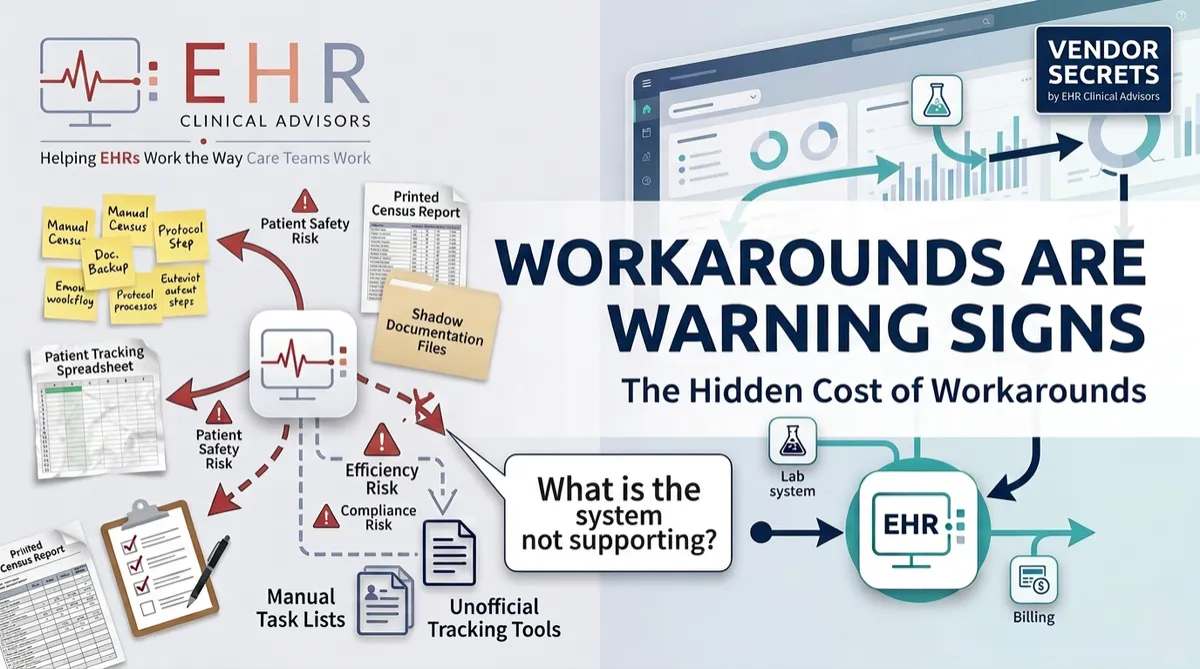
The Hidden Cost of EHR Workarounds
EHR Optimization, Patient Safety, Workflow Design
Electronic health record (EHR) workarounds can feel like harmless shortcuts - quick fixes that help clinicians “get through the day.” But beneath the surface, they quietly erode patient safety, compliance, efficiency, and trust in your EHR. In this Vendor Secrets by EHR Clinical Advisors article, we unpack how workarounds develop, why they’re risky, and how to systematically identify and address them without losing the valuable insight they reveal about your workflows.

How EHR Workarounds Develop in Everyday Practice
Workarounds rarely start as rebellion. They usually emerge from good intentions and real constraints. A nurse bypasses a required field because the patient is in pain and the admission form is long. A physician documents in a free-text note instead of structured fields because the template doesn’t match the way they think. A registrar copies yesterday’s insurance information forward so the waiting room moves faster.
Over time, these improvisations become the “real” workflow. New staff are trained on the workaround instead of the intended process. Leaders see that the EHR is technically in place and assume it’s working. Meanwhile, the gap between designed workflow and lived workflow widens, often unnoticed until something goes wrong.
📌 Key Takeaway: Workarounds are not just bad habits. They are signals that your EHR configuration, workflow design, or policies are misaligned with real-world clinical work.
The Risks Behind “Harmless” Workarounds
1. Patient Safety: Small Deviations, Big Consequences
Many workarounds directly touch medication orders, allergies, handoffs, and follow-up plans - areas where even minor errors can harm patients. Examples include:
Bypassing barcode medication administration when scanners are slow or unreliable
Documenting critical information (e.g., pain scores, fall risk) in free-text instead of discrete fields
Using “dummy” patients or generic orders for urgent situations, with plans to “clean it up later”
These behaviors may save seconds in the moment but can break clinical decision support, hide trends, and disrupt continuity of care. The result: missed alerts, duplicated therapies, and delayed recognition of clinical deterioration. From a patient’s perspective, the cost of a workaround can be a missed diagnosis, an adverse drug event, or an avoidable readmission.
2. Compliance: Invisible Variations, Visible Liability
Workarounds often slip outside approved policies and procedures. When staff share logins, document for one another, or skip required fields, they create compliance blind spots. This affects:
Regulatory requirements (e.g., documentation standards, time-stamping, authentication)
Accreditation expectations around medication safety, consent, and transitions of care
Audit trails that must clearly show who did what, when, and why
In investigations, surveyors and legal teams look for consistency between written policy and actual practice. Widespread workarounds make it difficult to demonstrate that your organization reliably follows its own rules, and that can be costly in fines, settlements, and reputational damage.
3. Efficiency: When Shortcuts Actually Slow You Down
At first glance, workarounds look like efficiency hacks. But when you zoom out to the full workflow, they often add hidden friction:
Extra steps to reconcile “side systems” like spreadsheets, sticky notes, and personal logs
Rework when documentation must be corrected or re-entered to meet billing or reporting needs
Delays as staff search for information that was documented in unexpected places
From an operational perspective, workarounds fragment the process. They prevent you from realizing the full benefit of EHR automation, such as streamlined order sets, automated routing, or integrated task lists, because part of the work now lives outside the system.
4. Data Quality: Flawed Inputs, Flawed Insights
Your EHR is only as valuable as the data it contains. Workarounds distort that data in subtle but powerful ways:
Important details locked in free-text notes instead of discrete fields, making them invisible to reports and decision support
Inconsistent use of problem lists, order sets, or visit types that breaks longitudinal tracking
“Workaround” values entered just to bypass hard stops (e.g., selecting a random diagnosis to close a visit)
The downstream impact is significant: quality metrics become unreliable, population health efforts misfire, and analytics-driven initiatives rest on a shaky foundation. Leadership may conclude that the EHR “can’t deliver value,” when the real issue is distorted data caused by workarounds.
5. Staff Satisfaction: Workarounds as a Symptom of Frustration
Clinicians rarely celebrate their workarounds. More often, they describe them with a mix of resignation and frustration: “This is the only way it works,” or “We’ve always had to do it like this.” Over time, this erodes:
Trust in the EHR and in leadership’s willingness to fix problems
Engagement in optimization efforts (“why bother, nothing changes”)
Morale, as people feel that technology is working against them instead of for them
When staff feel forced to choose between doing the right thing for the patient and following the “official” workflow, burnout follows. At EHR Clinical Advisors, we consistently see that addressing workarounds thoughtfully can be a powerful lever for improving clinician experience.
Before Fixing Workarounds, Understand Their Purpose
It’s tempting to declare, “No more workarounds,” and tighten enforcement. But eliminating a workaround without understanding what problem it is solving can backfire, pushing risk into a different part of the workflow or forcing staff into even riskier behaviors.
Every workaround answers a question like:
“How do I take care of this patient when the system doesn’t match reality?”
“How do I meet conflicting expectations from policy, the EHR, and the bedside?”
“How do I save time in a day that already feels impossible?”
Treat workarounds as valuable feedback. They highlight where workflow redesign, EHR configuration changes, automation, or policy updates are needed. The goal is not to punish creativity, it is to channel it into safer, standardized, and well-governed solutions.
💡 Pro Tip: When you discover a workaround, ask “What is this helping you accomplish?” before you ask “Why aren’t you following the process?”
How to Identify Workarounds: Observation and the Right Questions
Many leaders suspect workarounds exist but struggle to see them. Staff rarely label their actions as “workarounds”; to them, it’s just “how we get it done.” To surface them, you need both direct observation and curious questioning.
Spotting Workarounds Through Observation
Shadow real workflows. Watch clinicians admit, medicate, discharge, and hand off patients. Notice where they hesitate, backtrack, or step outside the EHR (paper notes, whiteboards, personal devices).
Compare to the “official” process. Have a copy of the documented workflow or policy and quietly note where reality diverges from design.
Look for repeated extra steps. If multiple people print the same report, keep side lists, or re-enter data, you’ve likely found a workaround.
Revealing Workarounds Through Questions
Create a psychologically safe space and ask open-ended questions such as:
“Walk me through how you really do this from start to finish.”
“Where do you feel the EHR slows you down or doesn’t fit the patient scenario?”
“Are there steps you do outside the EHR to make this easier or safer?”
“If you had to train a new colleague tomorrow, what would you show them that isn’t in the policy?”
The answers will quickly surface the “shadow workflows” that never made it into your EHR build or governance discussions, but drive daily practice.
A Practical Five-Step Assessment Process for Workarounds
To move from anecdotes to action, you need a structured way to assess and address workarounds. At Vendor Secrets by EHR Clinical Advisors, we recommend a five-step process that blends workflow redesign, EHR configuration, automation, policy updates, and governance.
Step 1: Document the Workaround in Detail
Capture exactly what is happening today:
Who uses the workaround (roles, departments, shifts)?
When and where it occurs in the workflow (e.g., admission, discharge, medication administration)
What tools are involved (EHR screens, paper forms, third-party systems, spreadsheets)
This is where a structured tool, like a Workaround Assessment Worksheet, is invaluable. It ensures you capture the full picture instead of reacting to a single observation.
Step 2: Clarify the Purpose and Drivers
Next, explore why the workaround exists. Ask:
What problem does this solve for the clinician or patient?
Is it compensating for a missing EHR feature, a confusing workflow, or a policy that doesn’t fit reality?
What would happen if staff stopped using the workaround tomorrow?
This step prevents you from simply “turning off” a workaround and unintentionally removing a safety net that staff rely on to protect patients or manage workload.
Step 3: Assess Risks and Impacts
Evaluate the workaround across the key domains we’ve discussed:
Patient safety: Could this lead to missed information, delayed treatment, or incorrect actions?
Compliance: Does it conflict with policy, regulatory requirements, or documentation standards?
Efficiency: Does it add steps, rework, or delays elsewhere in the process?
Data quality: Does it distort or hide data needed for reporting, analytics, or clinical decision support?
Staff satisfaction: Does it contribute to frustration, burnout, or distrust of the EHR?
Rate the severity and likelihood of each risk. This helps you prioritize which workarounds demand immediate attention and which can be addressed over time as part of broader optimization efforts.
Step 4: Design Safer, Sustainable Alternatives
With the purpose and risks clear, you can begin to design better solutions. This often involves a mix of:
Workflow redesign: Simplifying steps, clarifying roles, and aligning handoffs so the “right way” is also the easiest way.
EHR configuration changes: Adjusting templates, order sets, routing rules, or alerts to better match real-world scenarios.
Automation: Using the EHR to auto-populate data, trigger tasks, or send reminders so manual workarounds are no longer needed.
Policy updates: Revising policies that are outdated, overly rigid, or misaligned with current care models.
Include frontline staff in this design work. They understand the nuances of the workaround and can help you build a replacement that truly works in practice, not just on paper.
Step 5: Govern, Communicate, and Monitor
Finally, embed the new approach into your EHR governance structures:
Route significant workarounds and proposed solutions through your EHR or clinical governance committee for review and approval.
Update policies, training materials, and tip sheets to reflect the new standard workflow and configuration.
Communicate clearly why the change was made, how it improves safety and efficiency, and where staff can get support.
Monitor for recurrence of the workaround or emergence of new ones, using audits, feedback channels, and periodic observations.
Over time, this creates a culture where workarounds are surfaced early, evaluated thoughtfully, and resolved through coordinated workflow and EHR optimization, not left to spread quietly in the background.
Turn Workarounds into a Roadmap for EHR Improvement
The hidden cost of workarounds is real, but so is their value as a diagnostic tool. Each workaround tells you something specific about how your EHR, workflows, policies, and culture intersect. When you listen carefully, you gain a prioritized roadmap for improvement that directly supports patient safety, compliance, efficiency, data quality, and staff satisfaction.
Vendor Secrets by EHR Clinical Advisors was created to help organizations uncover these hidden patterns and translate them into practical, sustainable change. Rather than fighting workarounds in isolation, we help you redesign the system so that safer, more efficient behaviors become the natural default.
📌 Next Step: Use your current workarounds as a starting point - not a source of blame. They are some of the clearest clues you have about where your EHR and workflows need attention.
Ready to Assess Your Own Workarounds?
If you recognize your organization in this description (informal shortcuts, quiet frustration, and uncertainty about where to start) you don’t have to tackle it alone. Two practical resources can help you move from awareness to action:
Download the Workaround Assessment Worksheet. Use it to systematically capture, analyze, and prioritize workarounds across your departments, following the five-step process outlined above.
Schedule an EHR Workflow Assessment with EHR Clinical Advisors. Our team will observe real workflows, engage your clinicians, and help you design practical changes in workflow, configuration, automation, policy, and governance that reduce risk and restore confidence in your EHR.
The sooner you illuminate the hidden cost of workarounds, the sooner you can convert them into measurable gains in safety, compliance, efficiency, data quality, and staff satisfaction. Your clinicians are already telling you where the system needs to change. It’s time to listen, assess, and act.