The Demo Trap: How to Evaluate an EHR Against Real Clinical Work
Healthcare IT, EHR Selection, Clinical Operations
The Demo Trap: How to Evaluate an EHR Against Real Clinical Work
EHR demos are designed to impress. But for CIOs, CMIOs, CNOs, CFOs, project leaders, and selection committees, the real question is simple: will this system support the way our clinicians actually work? This is where many organizations fall into the “demo trap” and mistake polished features for sustainable workflows and adoption.
Why Workflows Matter More Than Features
Feature checklists feel objective, but they rarely predict success. Nearly every modern EHR can document a visit, order labs, or send prescriptions. The difference lies in how those actions fit into your real-world workflows across inpatient, ambulatory, perioperative, and post-acute settings.
A feature-centric evaluation asks, “Does it do X?”
A workflow-centric evaluation asks, “How easily can our teams complete X in their actual context?”
For leadership, this is not just a usability nuance; it is a financial and operational decision. Poorly aligned workflows drive overtime, workarounds, burnout, and stalled adoption—costs that never appear in the demo.
How Standard Vendor Demos Can Mislead Decision-Makers
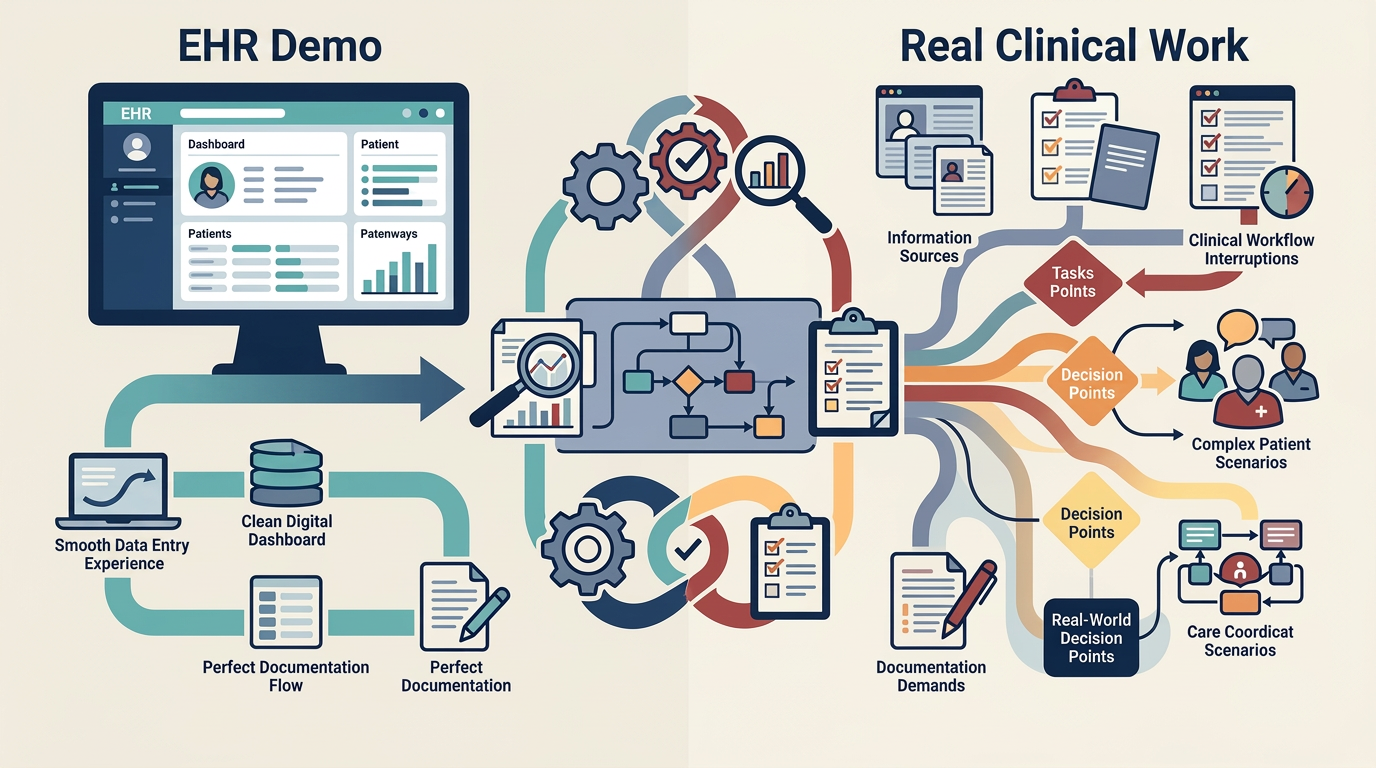
Standard demos are optimized to show the best day in the life of the EHR, not the average day in your organization. They often:
Use idealized patients with clean data and no edge cases
Avoid complex, cross-department handoffs that strain workflows in reality
Showcase heavily scripted paths that gloss over clicks, searches, and rework
The result is a polished experience that can mask issues with navigation, cognitive load, documentation burden, and care coordination—the very factors that determine whether clinicians will embrace or resist the system once it goes live.
Critical Questions to Ask About Usability and Real-World Scenarios
To move beyond the demo script, your committee should press vendors with targeted, workflow-focused questions such as:
What problem in our current workflow are we asking this technology to solve, and how will we know if it improves?
How many clicks and screens are required for a typical admission, discharge, or transfer for our patient populations?
Show us a complex, real-world case (e.g., sepsis, polypharmacy, social determinants) from triage through discharge and follow-up.
How does the system support handoffs between ED, inpatient, and post-acute teams without re-documentation?
What tools exist for rapid user configuration (favorites, order sets, templates) and who can maintain them?
How do you measure and improve time in chart, inbox burden, and alert fatigue across your client base?
💡 Pro Tip: Ask vendors to narrate not just what they are clicking, but why a clinician would take that path in a real shift.
Involving frontline clinicians in scenario design reveals gaps no demo script will show.
Before the Demo, Establish the Baseline
Before asking a vendor to show how its system will improve a workflow, understand how that workflow performs today.
For each critical workflow, document a small set of current-state measures:
How long does the work take?
What evidence tells us this is a problem today: observation, user feedback, operational data, support tickets, audit findings, or performance measures?
Where does rework occur?
Where is information entered more than once?
Where are clinicians or staff leaving the EHR to finish the work?
Which handoffs create delays or missing information?
What clinical, operational, financial, or workforce outcome are you trying to improve?
What would you measure later to know whether the new system actually made the work better?
The goal is not to create an exhaustive time-and-motion study for every process. It is to establish enough evidence to distinguish a workflow problem from a feature request and enough of a baseline to evaluate whether a proposed solution addresses the problem.
A demo question such as“Can your system do this?” tells you whether a capability exists.
A stronger question is:
“Here is what happens in this workflow today, here is where it breaks down, and here is the outcome we need to improve. Show us how your system would support that work.”
That changes the demo from a tour of capabilities into an evaluation of whether the technology can solve a problem your organization has actually defined.
Building Organization-Specific Demo Scenarios
To escape the demo trap, your organization should drive the agenda with custom scenarios that mirror your highest-risk, highest-volume, and highest-friction workflows. A structured approach can make organization-specific demos much more useful:
Identify 6–10 critical workflows across ED, inpatient, ambulatory, perioperative, and revenue cycle.
Define the current-state problem, desired outcome, and realistic patient story for each workflow, including comorbidities, social factors, exceptions, and cross-department touchpoints.
Provide each vendor with identical scenarios and clear expectations for how they will be demonstrated.
Require vendors to show out-of-the-box capabilities first, then clearly identify what requires configuration, customization, third-party technology, or additional services.
This levels the playing field and makes it much easier for your committee to compare systems on what truly matters: how well the EHR supports your way of delivering care.
Involving Frontline Users Early and Often
Successful organizations treat frontline clinicians as co-designers of the evaluation, not just end-users informed after the fact. Include:
Bedside nurses, charge nurses, and nurse leaders for inpatient and procedural workflows
Hospitalists, ED physicians, surgeons, and advanced practice providers for high-acuity scenarios
Ambulatory providers, care coordinators, and schedulers for access and continuity of care
For workflows that extend beyond direct care, include the people who actually perform the work in registration, HIM, pharmacy, revenue cycle, scheduling, laboratory, imaging, and other affected operational areas.
Their feedback on navigation, documentation effort, clinical decision support, and communication tools will often differ from leadership impressions—and can prevent costly misalignment down the road.
Using a Structured Scoring Model for Vendor Comparisons
Once you have scenario-driven demos, you need a way to capture feedback that is consistent, comparable, and defensible. A structured scoring model helps your committee move beyond “I liked it” or “It felt clunky” to measurable insights.
Define criteria such as workflow fit, usability, configuration flexibility, reporting, interoperability, training and support, and total cost of ownership.
Tie scenario scores back to the current-state problem and desired outcome you defined before the demo. A system should not receive a high score simply because the workflow looked polished if it failed to address the problem the scenario was designed to test.
Weight each criterion based on your strategic priorities (e.g., nursing efficiency, ambulatory growth, quality measures, revenue integrity).
Provide standardized scoring tools for all participants and collect results immediately after each demo.
Score demonstrated performance, not promised future capability. If a workflow depends on future development, customization, third-party technology, additional services, or an unvalidated configuration change, document that separately rather than scoring it as if it were demonstrated.
📌 Key Takeaway: A disciplined scoring model turns subjective impressions into a clear, data-informed recommendation for your board and executive team.
Looking Beyond Go-Live: Adoption and Operational Success
The EHR you select will shape your organization’s clinical, financial, and operational performance for a decade or more. Evaluating only the demo experience ignores critical questions about long-term adoption and sustainability:
How will this system support continuous optimization, regulatory changes, and new care models?
What does successful adoption look like at 12, 24, and 36 months—for clinicians, patients, and finance?
How do other clients measure and improve productivity, satisfaction, and burnout post-implementation?
Those post-live measures are considerably more useful when the organization established the baseline before selection. If documentation time, duplicate work, handoff delays, clinician burden, throughput, or another outcome influenced the buying decision, preserve that measure through implementation and revisit it after go-live. Otherwise, organizations can end up knowing that the EHR was successfully implemented without knowing whether the work actually improved.
Aligning your selection with long-term operational goals ensures the EHR becomes a strategic asset, not just a compliance requirement or cost center.
The Bottom Line
The best EHR demo isn’t the one that leaves your committee most impressed.
It’s the one that leaves your committee with the fewest unanswered questions.
Give vendors your workflows instead of relying solely on theirs. Test the difficult handoffs. Bring frontline users into the evaluation. Separate what works out of the box from what requires configuration, customization, third-party technology, or additional services. And score what you actually observe.
A polished demonstration can show you what an EHR is capable of. A disciplined evaluation helps you determine whether those capabilities actually fit the way your organization delivers care.
Because selecting an EHR isn’t about finding the system that performs best in the demo room.
It’s about finding the system that can perform when the demo room is gone and the real work begins.