The Real Cost Isn't the Contract
Healthcare Technology, EHR Strategy
The Real Cost Isn't the Contract
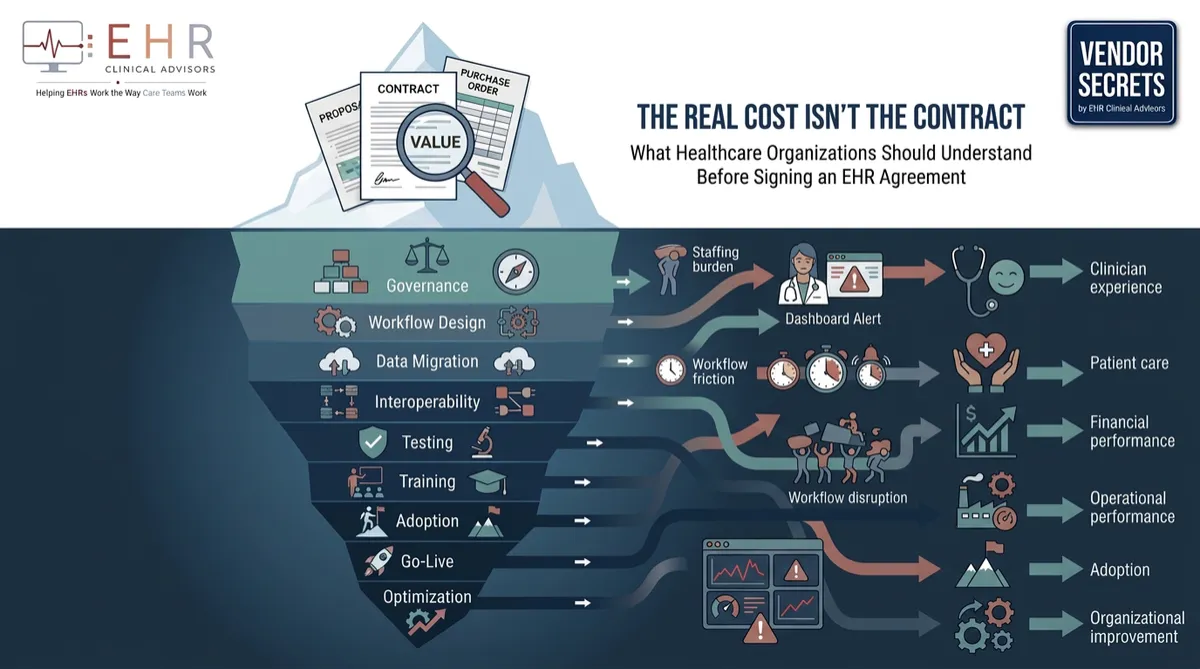
Most healthcare organizations focus on the wrong number when evaluating EHR investments. At EHR Clinical Advisors, we help teams look beyond the purchase price to the full cost of making technology successful.
Contract negotiations can take months. Vendors present pricing models, implementation estimates, licensing costs, and support packages. Committees compare proposals, build business cases, and negotiate terms.
Yet the contract price is only part of the investment. The largest costs often emerge later through workflow redesign, governance decisions, internal staffing, adoption challenges, optimization efforts, and operational disruption.
Organizations frequently ask:
“What will this EHR cost?”
The better question is:
“What will it cost to make this EHR successful?”
That distinction often determines whether an EHR becomes a strategic asset or an expensive source of frustration.
The Contract Is a Starting Point, Not a Finish Line
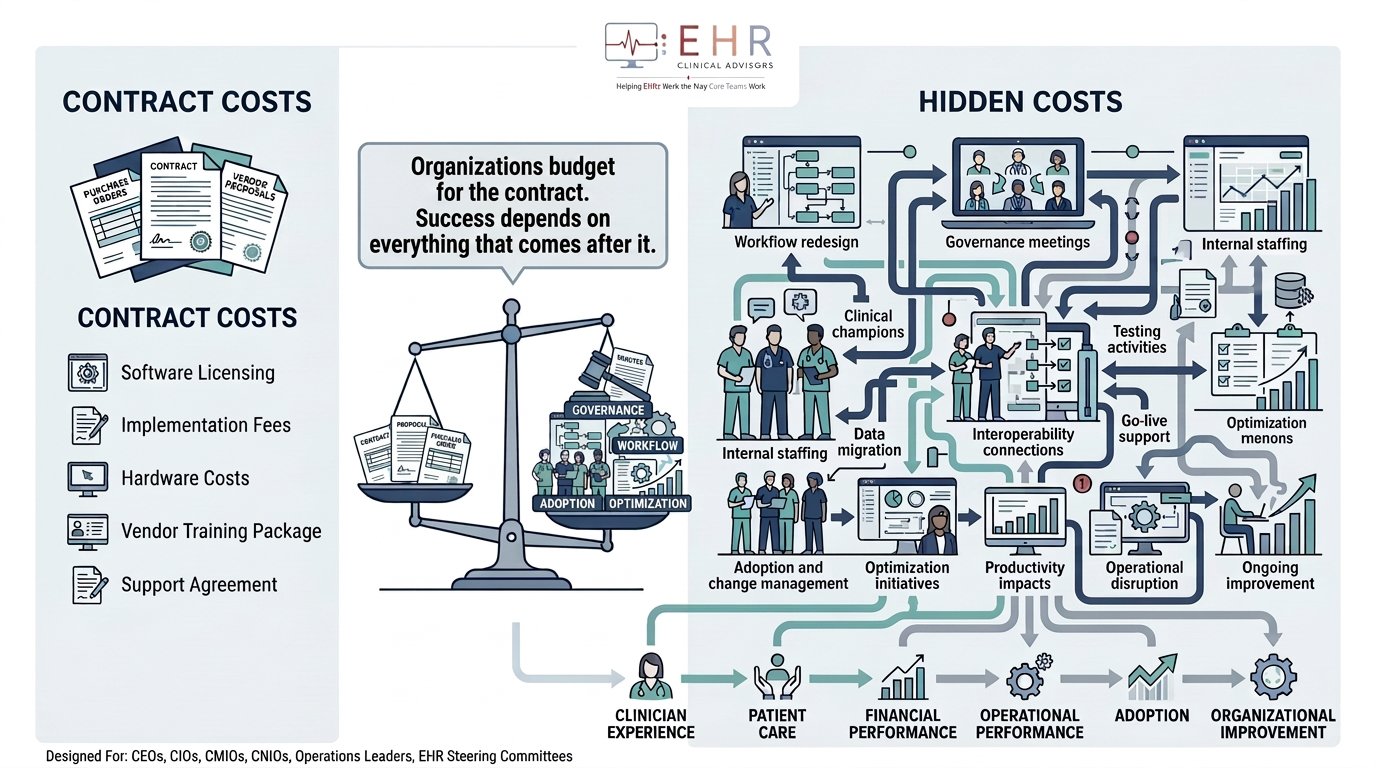
Signing the contract feels like a major milestone. In reality, it marks the beginning of the most resource‑intensive phase of the journey.
After selection comes:
Governance
Workflow redesign
Data conversion
Interface development
Testing
Training
Go‑live support
Stabilization
Optimization
Each requires time, effort, and organizational attention. Many organizations underestimate these demands because none appear as prominently during vendor negotiations as software pricing does.
The Cost of Workflow Misalignment
A system can satisfy every contractual requirement and still make everyday work harder.
When workflows do not align with clinical reality, organizations begin paying for that misalignment through:
Longer documentation time
Reduced productivity
Increased overtime
User frustration
Burnout
Workarounds
The complaint usually sounds familiar:
“The system can do it, but that's not how we actually work.”
A workflow problem eventually becomes an operational and financial problem. This is why workflow fit matters as much as functionality during selection.
The Cost of Hidden Staffing
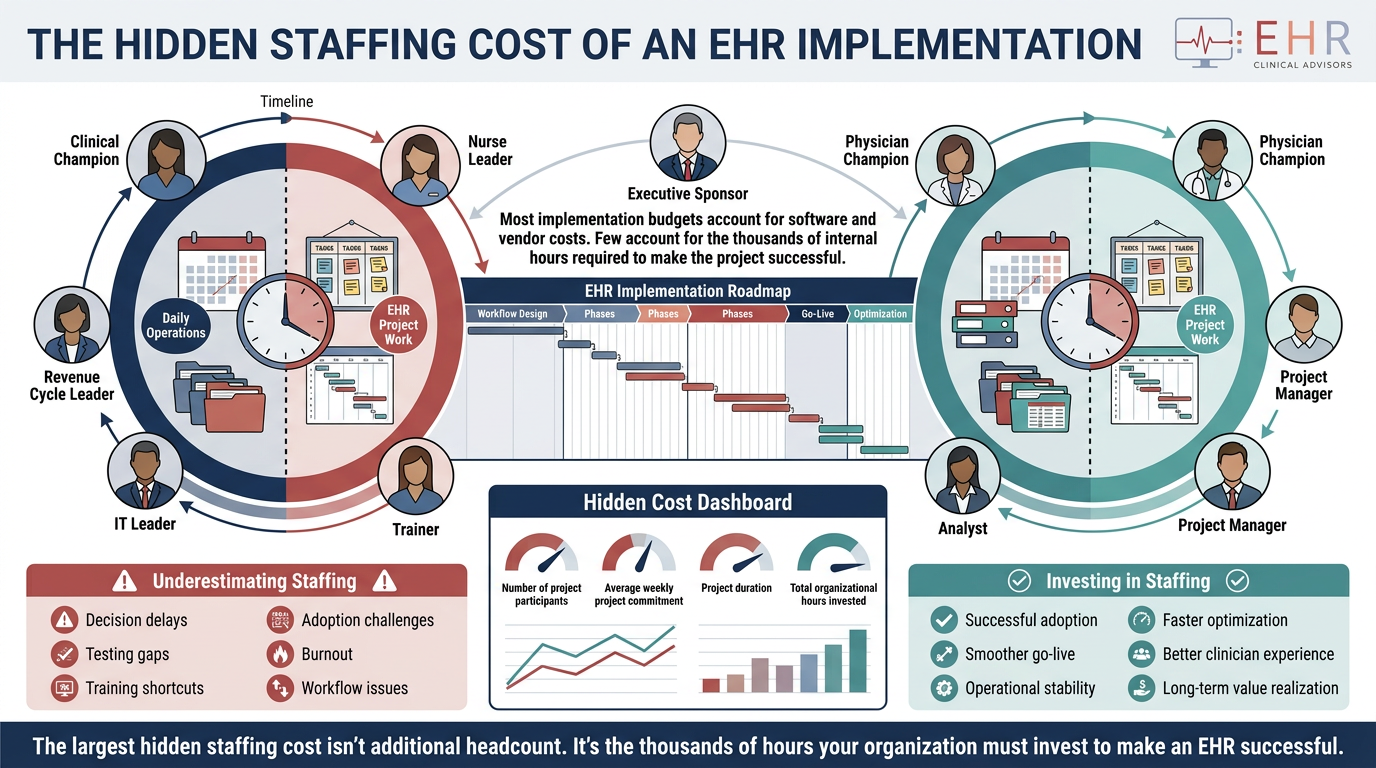
Every successful EHR project relies on people.
Clinical champions
Operational leaders
Analysts
Trainers
Testing participants
Executive sponsors
The challenge is that these individuals rarely stop doing their regular jobs. Implementation often becomes a second job layered on top of existing responsibilities.
When organizations fail to allocate sufficient time, backfill key roles, or plan for internal effort, projects slow down, decisions are delayed, and burnout increases. Many of the most expensive implementation challenges are actually staffing challenges in disguise.
The Cost of Data Conversion
Clinicians trust information more than technology. If historical data is incomplete, inaccurate, difficult to find, or missing altogether, confidence in the system erodes quickly.
Data conversion affects:
Clinical decision making
Patient safety
Productivity
Adoption
Trust
Organizations often discover after go‑live that seemingly minor migration issues create significant operational challenges for years. Good conversions are largely invisible. Poor conversions become impossible to ignore.
The Cost of Integration
Interoperability is often discussed as a project task. In reality, it is an ongoing operational responsibility.
Interfaces connect:
Laboratories
Imaging systems
Revenue cycle platforms
Health information exchanges
Pharmacy systems
Third‑party applications
When integrations fail, clinicians create workarounds, staff perform manual reconciliation, and revenue cycle processes become more complicated. The cost is rarely the interface itself. The cost is what happens when the interface does not work.
The Cost of Poor Adoption
An EHR is only as valuable as its utilization. A technically successful implementation can still fail to achieve its goals if adoption struggles follow.
Poor adoption typically creates:
Productivity losses
Additional training needs
Increased support requests
Documentation inconsistencies
Data quality issues
User frustration
Many organizations describe these as technology problems. More often, they are adoption, workflow, governance, or change‑management problems.
The Cost of Workarounds
Every healthcare organization has workarounds. The question is whether leadership understands why they exist.
Workarounds are often created by good people trying to solve real problems. They may be attempts to:
Save time
Navigate workflow barriers
Work around system limitations
Deliver care despite process challenges
The mistake many organizations make is trying to eliminate the workaround before understanding its purpose. Workarounds are not just process deviations.
Workarounds are data.
They reveal where technology, workflows, policies, and reality have drifted apart.
The Cost of Delayed Optimization
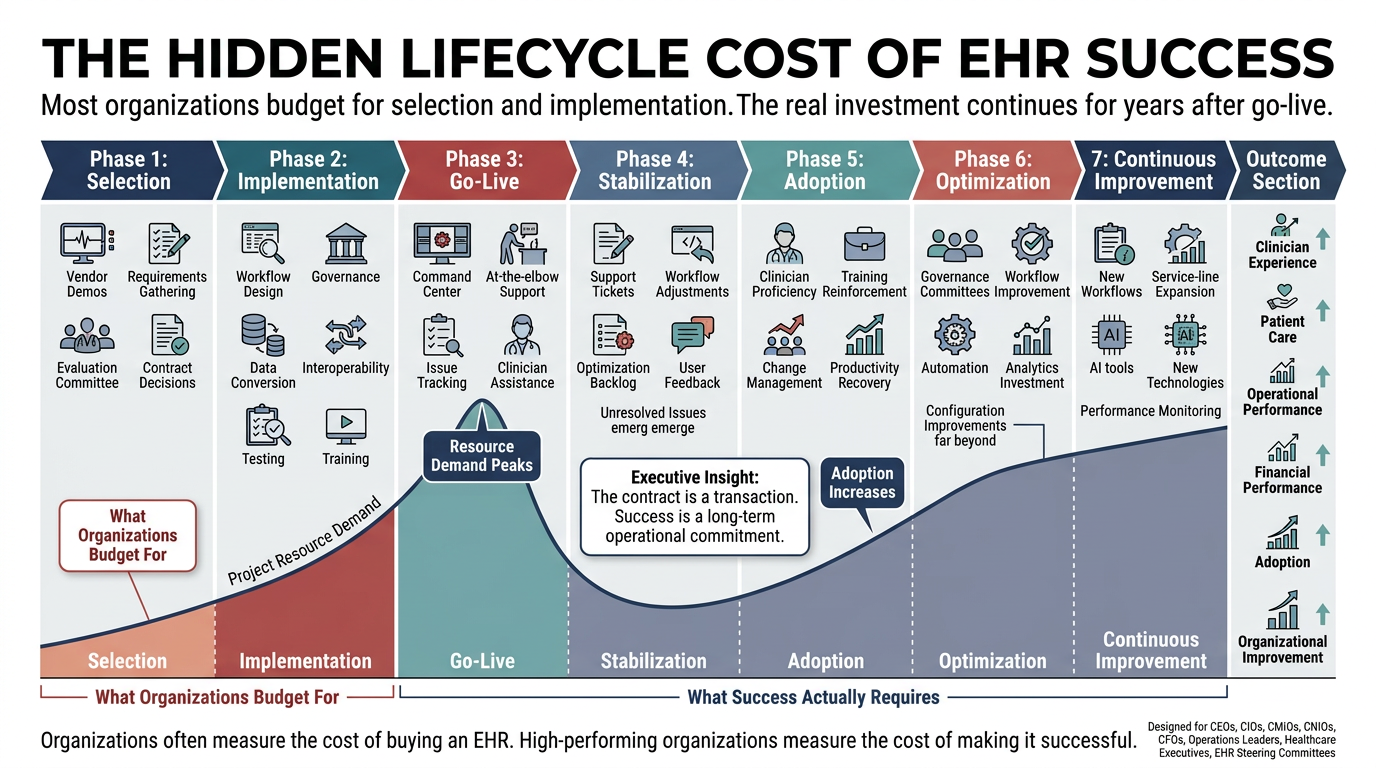
Many organizations view optimization as a future project, something to worry about after implementation.
But optimization is not a phase. It is a capability.
Regulations change
Staff turnover occurs
New technologies emerge
Service lines evolve
Without ongoing optimization, the gap between how the system was designed and how the organization actually operates grows larger over time. That gap is eventually filled by:
Workarounds
Productivity losses
Frustration
Missed value
The question is not whether optimization will be necessary. The question is whether it will be planned or reactive.
Questions to Ask Before You Sign
Before signing a contract, ask:
What internal resources will we need throughout implementation?
Which workflows are most likely to require redesign?
What does successful adoption look like 12 months after go‑live?
What optimization activities are typically required after implementation?
What challenges do existing customers most frequently encounter?
What operational impacts should we expect during implementation and stabilization?
How do high‑performing organizations maximize value from the system?
The answers often tell you more than the demo and sometimes more than the contract itself.
The Bottom Line
The contract matters. But it is rarely the most expensive part of the investment.
The true cost of an EHR includes:
People
Workflows
Governance
Adoption
Operational impacts
Optimization
Organizations that focus only on purchase price often underestimate what it takes to achieve meaningful clinical, operational, and financial outcomes. The most successful organizations ask a different question:
📌 Key Takeaway: What will it cost to make this successful, not just what will it cost to buy?
That answer is often the most important EHR vendor secret of all.