If End Users Are Not in the Room, You Are Buying Blind
Healthcare IT, EHR Strategy, Clinical Workflow
If End Users Are Not in the Room, You Are Buying Blind
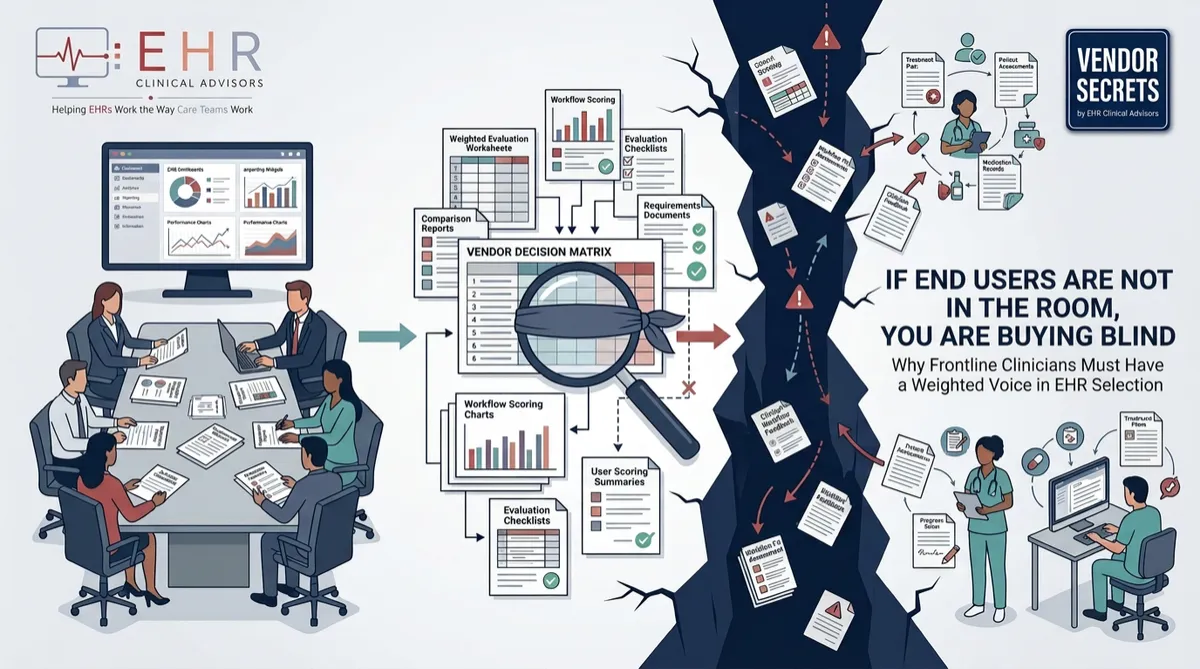
Electronic health record decisions shape every clinical encounter. When frontline clinicians are missing from the evaluation table, organizations risk investing in systems that look impressive in a demo but fail at the bedside, in the exam room, and at the nurses’ station.
Why Frontline Clinicians Must Shape EHR Selection
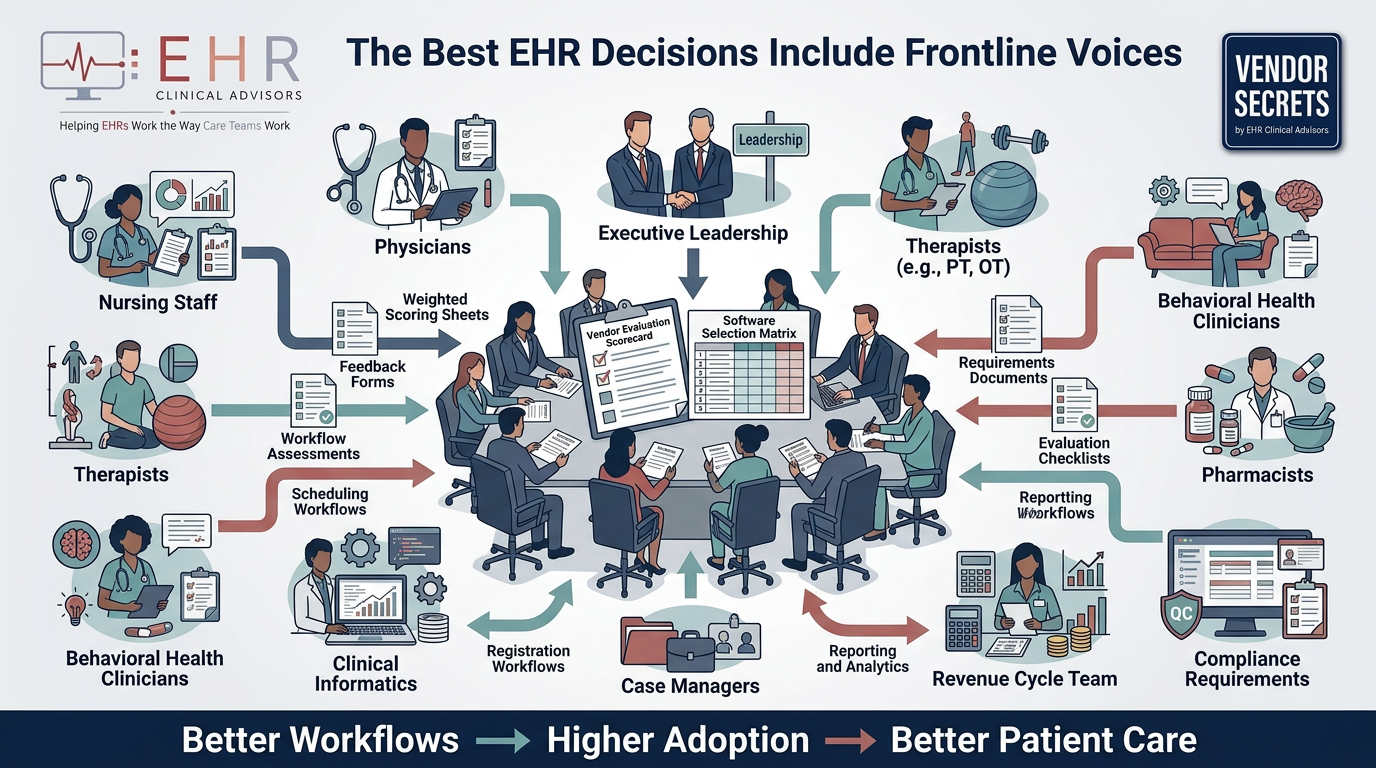
The people who live in the EHR every day (physicians, nurses, advanced practice providers, therapists, pharmacists, and support staff) see dimensions of the system that executives and vendors simply cannot. They navigate dozens of patient charts a day, manage competing demands, and balance documentation requirements with limited time at the bedside. Their experience is the most accurate indicator of whether a system will support safe, efficient care or quietly erode it.
Involving frontline clinicians in EHR selection is not a courtesy; it is a safety, quality, and workforce-retention strategy. When their voices are sidelined, organizations often discover too late that routine tasks take longer, orders are harder to enter, and documentation becomes a daily source of frustration and burnout.
What Real-World Workflows Reveal That Demos Hide
Vendor demonstrations are designed to impress. They highlight best-case scenarios, curated screens, and idealized patient journeys. But clinical reality is messy. A single shift might include complex comorbidities, urgent add-on cases, incomplete outside records, and rapid handoffs between teams. Only real workflows, run by real end users, can expose how an EHR behaves under that kind of pressure.
A nurse juggling four high-acuity patients may uncover that a “simple” medication administration process actually requires multiple extra clicks and screen changes.
A primary care physician may find that documenting a common chronic disease visit doubles in time when real data, problem lists, and health maintenance tasks are involved.
A pharmacist may notice that order verification screens bury critical safety information behind collapsible sections that no one opens during a busy shift.
These issues rarely appear in a scripted demo, yet they determine whether the EHR truly supports clinical care or quietly introduces risk.
Bring Clinical, Operational, and Technical Voices in Early and Keep Them There
Effective EHR selection is a team sport. Clinical leaders, operations executives, and IT professionals each hold a piece of the puzzle. They need to be involved from the first conversation about requirements through final contract negotiations.
Clinical stakeholders define what safe, usable workflows look like and which pain points must be solved.
Operational leaders connect system capabilities to throughput, staffing, scheduling, and financial performance.
Technical teams assess interoperability, data migration, infrastructure requirements, and long-term support.
When any one of these groups is invited in late, after shortlists are set or pricing is nearly final, organizations are forced into compromises that could have been avoided with earlier, deeper collaboration.
Clinicians’ Input Should Carry Real Weight, Not Just Appear on the Agenda
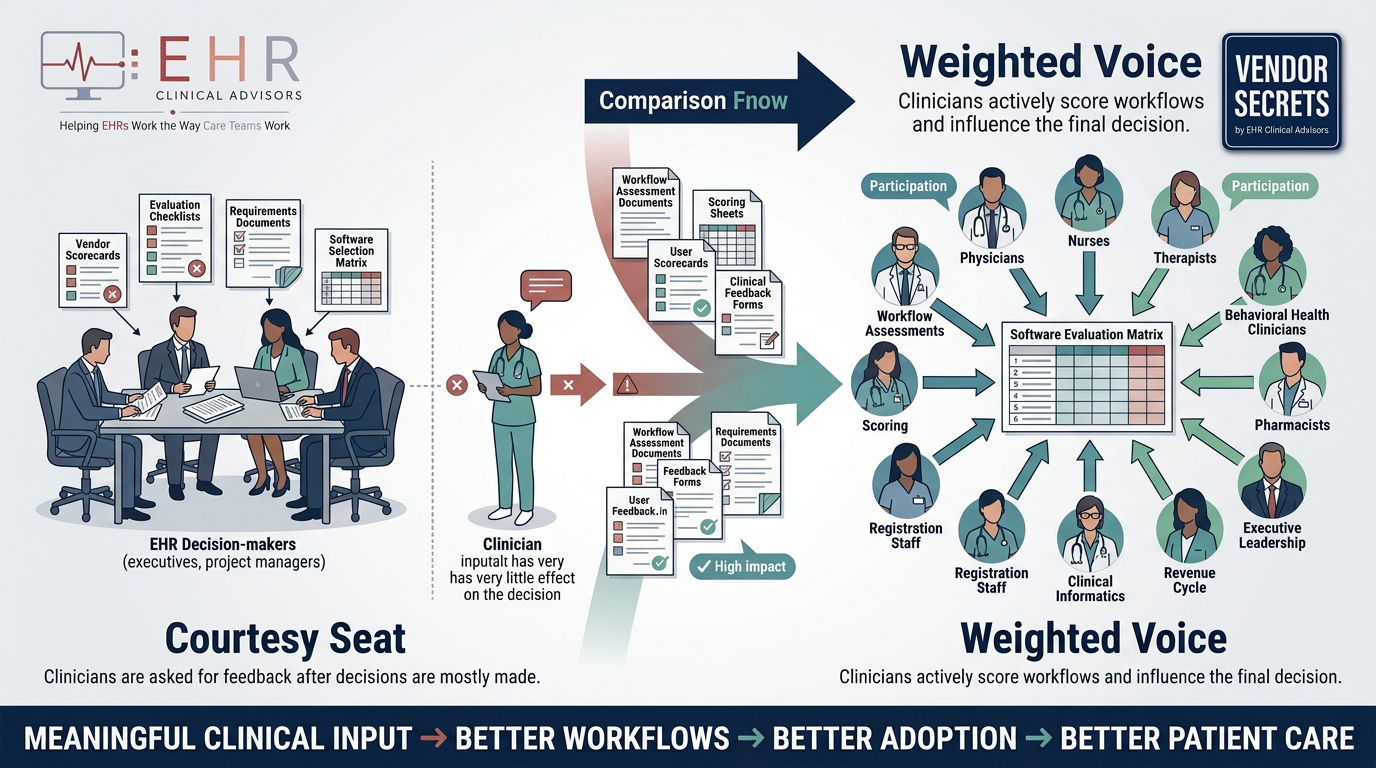
Many organizations can point to clinician participation on selection committees, but fewer can show how that input meaningfully shaped the outcome. Token involvement is a major risk. If clinicians are present but overruled whenever usability conflicts with cost, timeline, or existing contracts, the process sends a clear message: their experience matters less than convenience.
To avoid this, decision frameworks should explicitly assign significant weight to clinician feedback on usability, safety, and workflow fit. When frontline users strongly favor or reject a system based on hands-on testing, that signal should be central to the final decision, not a footnote in the committee minutes.
The Hidden Risks of Superficial Participation
Superficial participation often looks reasonable on paper: a few clinicians attend vendor demos, fill out brief surveys, and are thanked for their time. Yet without structured scenarios, clear evaluation criteria, and protected time to engage, their feedback is necessarily shallow. They are reacting to what they see, not to how the system behaves in the real work they do.
The consequences show up later as:
Unexpected documentation burdens that lengthen every visit or shift.
Workarounds and shadow systems that fragment data and increase risk.
Frustration that fuels burnout, turnover, and resistance to future change.
💡 Pro Tip: Protect real time on clinicians’ schedules for evaluation activities and treat that time as an investment in safety, quality, and retention, not as an optional extra.
Structured Criteria and Real Workflow Testing Change the Conversation
The most reliable way to avoid “buying blind” is to pair structured evaluation criteria with realistic workflow testing. Instead of asking, “Do you like this system?” organizations can ask, “How well did it support these ten critical tasks?” and “What risks or delays did you encounter?”
Define key workflows, such as admission, discharge, medication reconciliation, cross-coverage handoffs, and common clinic visits, and require vendors to support scenario-based testing.
Use standardized scoring tools that capture usability, safety, efficiency, and cognitive load for each scenario.
Aggregate results across clinical, operational, and technical reviewers so trade-offs are visible and explicit.
This approach moves the discussion from opinions and impressions to observable performance. It also gives clinicians a clear framework for their input, making it easier for leadership to act on what they learn.
The Bottom Line: Those Who Live in the EHR Deserve the Strongest Voice
At its core, EHR selection is a decision about how clinicians will spend thousands of hours over the coming years. Every extra click, every confusing alert, every hard-to-find data element adds up. The people who spend the most time in the EHR should have the strongest voice in evaluating it.
When frontline users are deeply involved, supported with structured criteria, and given real workflow testing opportunities, organizations make better choices. Choices that support safer care, smoother operations, and a more sustainable experience for clinicians. When they are not in the room, leaders are, quite literally, buying blind.